

Maison de l'Environnement
Play
Client
Maison de l'Environnement
Role
Designer
Duration
7 months (2024-2025)
Challenge
Children today are growing up increasingly disconnected from nature, unstructured play, and meaningful time with their families. In urban environments, nearly 90% of their time is spent indoors, often engaged in screen-based activities. What was once a natural part of childhood exploration, curiosity, and real world interaction has been replaced by passive digital experiences.
This shift presents a critical UX challenge: how might we design experiences that encourage children to reconnect with both nature and their families in a way that fits into modern urban life?
Did you know?
INDIA
Over half of children in India play outside for one hour or less each day.

FRANCE
According to the Multinational Time Use Study (MTUS), the average person spends approximately 3.7 hours outdoors daily, accounting for about 15% of a full day.
USA
A study by the Seattle Children’s Research Institute found that children aged 10 to 16 engage in only about 12.6 minutes of vigorous outdoor activity daily
AUSTRALIA
Children aged 8 to 12 in Australia spend an average around 90 minutes per day outdoors.
UK
Children aged 8 to 15 spent an average of 68 minutes per day participating in outdoor activities, sports, or active travel.
SINGAPORE
Children aged 8 to 12 in Singapore spend about 60 minutes outdoors daily.

indoor cozy adventures
open-air explorations
Look dad,
I’m a monkey!
Bravo!
‘‘My daughter didn’t like tomatoes, until
she picked one herself in the garden and now she loves them!"
‘‘My daughter didn’t like tomatoes, until
she picked one herself in the garden and now she loves them!"
factors contributing to the lack of "vitamin N”

The Magical Secret Garden is an immersive, multi-touchpoint experience designed as a journey
rather than a single event.
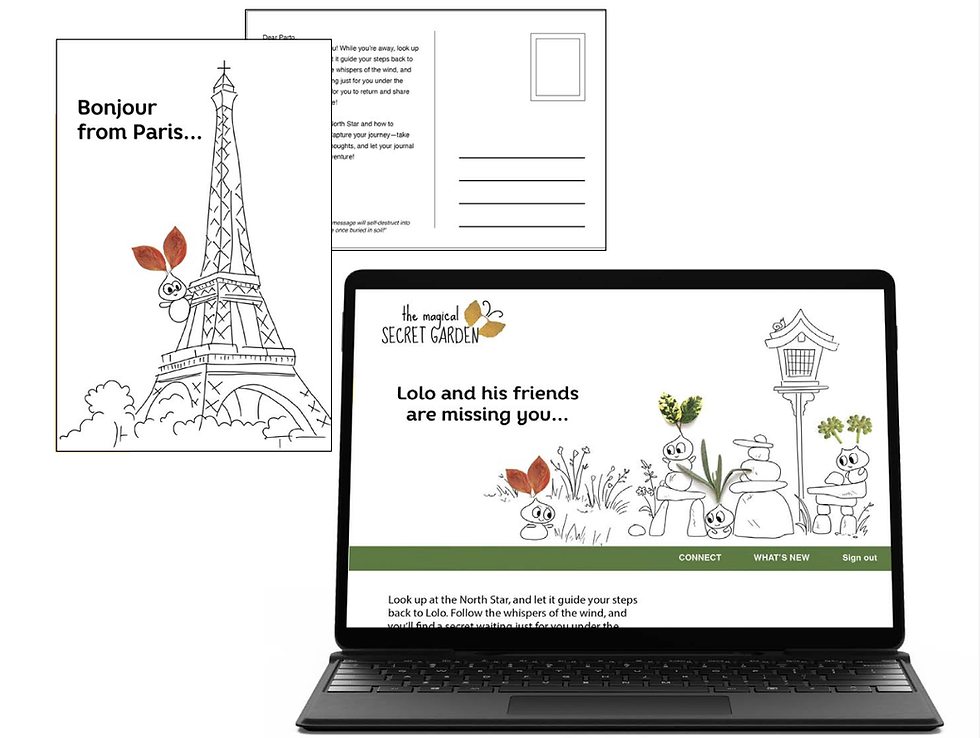
The experience begins with a curiobag containing: A storybook A journal Lolo (a toy/plant which needs your help to find his way back home) Seeds The story introduces the child to Lolo’s world and ends with a sealed envelope containing a map. The map transforms passive reading into active exploration by guiding families to real outdoor locations. At each marked location, children complete nature based tasks that encourage observation, creativity, and reflection. They document their findings in the journal, reinforcing learning through active participation. The journey culminates in reaching Lolo’s House the Magical Secret Garden, a physical immersive environment where children engage in hands-on activities connected to biodiversity and environmental awareness. Importantly, the system is cyclical. After visiting the garden, new tasks invite families to return, transforming the experience into an ongoing relationship rather than a one time visit.

Imagine a garden

_mov.jpg)

To find this magical secret garden all you need to do is Play!


By collaborating with local environmental groups, children not only explore and learn new things, but also spend time outdoors while appreciating the value of hard work in achieving meaningful goals.
Upon completing all the tasks, they unlock the location of the real Magical Secret Garden.
Lets see how the magic turns into reality in the garden


UI Design



_mov.jpg)

See you soon!